
Built for steady movement in busy prep areas
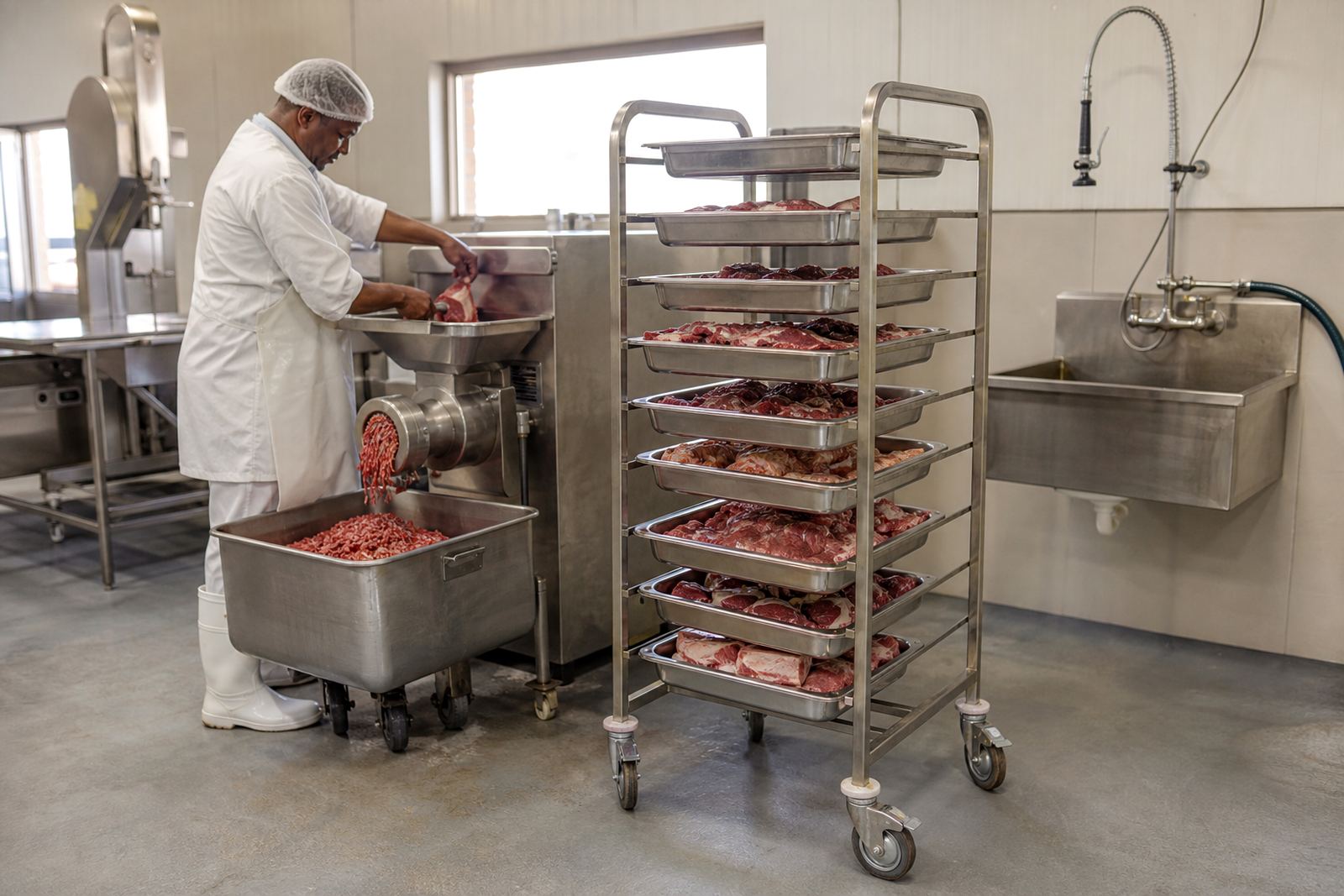
Meat trolleys are mobile handling units used to move meat, crates, trays and prep materials through a butchery with less strain on staff. In a busy shop, abattoir room or food prep area, they help keep product off the floor and reduce the stop-start lifting that slows the day down.
Most buyers want a trolley that rolls smoothly, turns in tight spaces and is easy to wash down after use. For that reason, the common choices are stainless steel or galvanised steel frames, with food-safe construction and castor wheels that can handle daily movement. Some units are open tray style, while others are deeper for bulk cuts or ingredients. The right choice depends on what you move, how often you move it and how narrow your prep lanes are.
These trolleys are not powered, so there is no electrical supply or gas connection needed. That makes them simple to place in front shops, back rooms, cold stores and loading areas without planning around plugs or cylinders. If the trolley will be used near chilled rooms or in a coastal town with higher humidity, it is worth asking about corrosion resistance and wheel quality before ordering.
Size options that suit small shops and larger rooms
Meat trolleys come in different lengths, widths and load setups so they can fit the space and the work being done. A smaller shop in Bloemfontein or Kroonstad may need a compact trolley that turns easily around a cutting bench. A larger operation in Johannesburg or Durban may prefer a wider unit that carries more product in one trip.
When checking sizes, look at the usable tray area rather than overall frame size alone. The trolley must pass through doors, cold-room entries and narrow aisles without banging into walls or counters. Wheel diameter and castor movement matter too, especially where there are floor joints, drains or slightly uneven concrete.
Some buyers want a single-level trolley for quick transport. Others need a multi-shelf or deep-basin style for grouped cuts and loose items. If the trolley is moving heavier loads, you should also check the wheel locking setup and the handle height so staff can push it safely. A trolley that is too small can create more trips and more handling, which defeats the point.
- Compact sizes for tighter prep rooms and smaller butcheries
- Larger formats for bulk movement and high-throughput work
- Open, tray-style and deeper-basin options available
- Castors and handles should match the floor and load pattern
Where meat trolleys fit best in the workflow
These trolleys suit butcheries, meat prep rooms, supermarket back areas, caterers and home butchers who want better control when moving ingredients. They are especially useful between cold storage and the cutting area, or from the prep bench to the packing point. In places with frequent deliveries and quick turnaround, the trolley saves time and keeps product movement more orderly.
They also help where staff work in shifts and need a consistent way to move items without bending and lifting too much. That can matter in municipal food spaces where cleanliness and workflow separation are important. A trolley can be assigned to raw product, another to packed items, and a third to cleaning or ingredients if the operation is set up that way.
For home butchers, a smaller trolley can be helpful when processing larger cuts at home or moving trays between a garage prep area and a cold room. In that setting, the main thing is easy cleaning and wheels that do not leave marks on the floor. If the trolley is used outdoors for a short run, make sure it is stored dry afterwards so rust does not start around the joints and castors.
What to check before you order
Before placing an order, it helps to confirm the load you want to move, the width of the passages, and whether the trolley must fit through a cold-room door or a narrow rear entrance. You should also decide whether you need an open frame, a tray top or a deeper holding surface. If your staff wear gloves and work quickly, a simple handle and good wheel action often matters more than extra detail.
Ask about the wheel type if the floor is smooth tile, rough concrete or lightly uneven. Locking wheels are useful where the trolley must stay still during loading. If you are operating in coastal areas like Cape Town or Durban, or in rooms with frequent washdowns, it is smart to choose materials and fittings that are easier to keep in good order. That small detail can extend the life of the trolley quite a lot.
Also check whether the trolley will be used with raw meat only, or also with ingredients, packaging and cleaning items. That affects how often it needs to be sanitised and whether separate colour or purpose controls are needed internally. If you are unsure, share the room layout and the usual work pattern so the right size can be matched the first time around.
- Measure doorways, aisles and turning space first
- Confirm the typical load and how often it moves
- Choose wheels that suit your floor type
- Decide if you need a lockable trolley for loading stops
Care, cleaning and safe day-to-day use
Like any food-handling item, a meat trolley needs regular cleaning after use. Wash down all product-contact surfaces, dry the frame and check the wheels for fat build-up, string, packaging bits or bone fragments. If the trolley has removable trays or inserts, take them out during cleaning so there are no hidden corners left dirty.
Operators should use basic PPE where needed, including gloves and suitable footwear, especially on wet floors. Keep hands clear of moving wheels and do not overload a trolley beyond what staff can handle safely. It is also worth checking that guards, stops and any locking parts are still working properly. If a wheel is wobbling or the frame has started to bend, take the trolley out of service until it is sorted.
Good cleaning habits matter in winter too, when cool rooms and damp floors can leave moisture sitting longer than expected. A trolley that is rinsed and dried properly will last longer and stay cleaner. If your team uses it daily, add it to the normal service schedule with the rest of your prep equipment so wear is caught early, not after an avoidable breakdown.
MorCut supply and support from Bloemfontein
MorCut Butchery supplies meat trolleys from Hamilton in Bloemfontein to commercial and home butchers across South Africa. We work with customers in Bloemfontein, Johannesburg, Pretoria, Durban, Cape Town, Kimberley, Welkom and Kroonstad, with delivery and setup arranged according to the order and location. If a trolley is part of a larger prep room setup, we can also assist with related equipment and practical servicing advice.
Our team includes people who handle sales, service coordination, workshop support, parts and training, so you get guidance that matches how the trolley will be used on site. That is useful when the buying decision depends on floor space, hygiene routines, staff movement or a busy receiving bay. If needed, we can talk through the everyday setup and what to check before the order is finalised.
To enquire, use the form on our contact page and share the sizes you need, the type of work area and where the trolley will be used. That helps us respond with the right options and avoid delays, especially where the site is on a tight schedule or the floor plan is a bit awkward.
Key facts
| Product type | Mobile meat trolley for prep, transfer and short-distance handling |
|---|---|
| Frame material | Stainless steel or galvanised steel, depending on application |
| Wheel setup | Swivel castors with locking option on selected units |
| Configuration | Open frame, tray top or deeper holding style |
| Use areas | Butchery prep rooms, cold rooms, packing zones and receiving areas |
| Power or gas | Not required |